
HyTerra Opens Kansas Hydrogen Dataset to US University Research Under Chimaera Fund Program
HyTerra will collaborate with research teams from three US universities using exploration data and samples generated from the company’s Kansas natural hydrogen activities, creating a new research program focused on how hydrogen is generated, migrates and accumulates within the subsurface.
The teams from Texas A&M University, the University of Texas at Austin and the New Mexico Institute of Mining and Technology were selected through the Chimaera Fund’s Geologic Hydrogen Site Access Challenge. HyTerra will work directly with the researchers and receive early and ongoing access to their data, analysis and findings before broader publication.
That early-access arrangement is the most immediately relevant component for HyTerra.
Rather than waiting until the studies are completed and published, the company will be able to assess emerging research alongside its own drilling, production-testing, geophysical and laboratory results. HyTerra intends to incorporate relevant findings into its technical framework and the criteria it uses to rank prospects and other opportunities.
The research will examine four areas with direct implications for geologic hydrogen exploration.
One team will investigate whether conventional wireline logs can be used to identify intervals that may be generating or containing hydrogen. Another focus will be the hydrogen-generation potential of different rock types associated with the Mid-Continent Rift, together with estimates of how quickly those rocks could generate hydrogen under relevant conditions.
The researchers will also examine how geological, geochemical and well information can be integrated to improve models describing hydrogen generation, migration and accumulation.
Those questions address some of the central uncertainties facing the emerging geologic hydrogen industry.
Exploration companies increasingly have tools for identifying surface anomalies and testing hydrogen concentrations in wells, but determining why hydrogen occurs in a particular location — and whether the same geological relationships can be used to predict other accumulations — requires a stronger understanding of source rocks, reaction rates, migration pathways, reservoirs and trapping conditions.
HyTerra’s Kansas program provides the researchers with a real-world dataset against which those questions can be investigated.
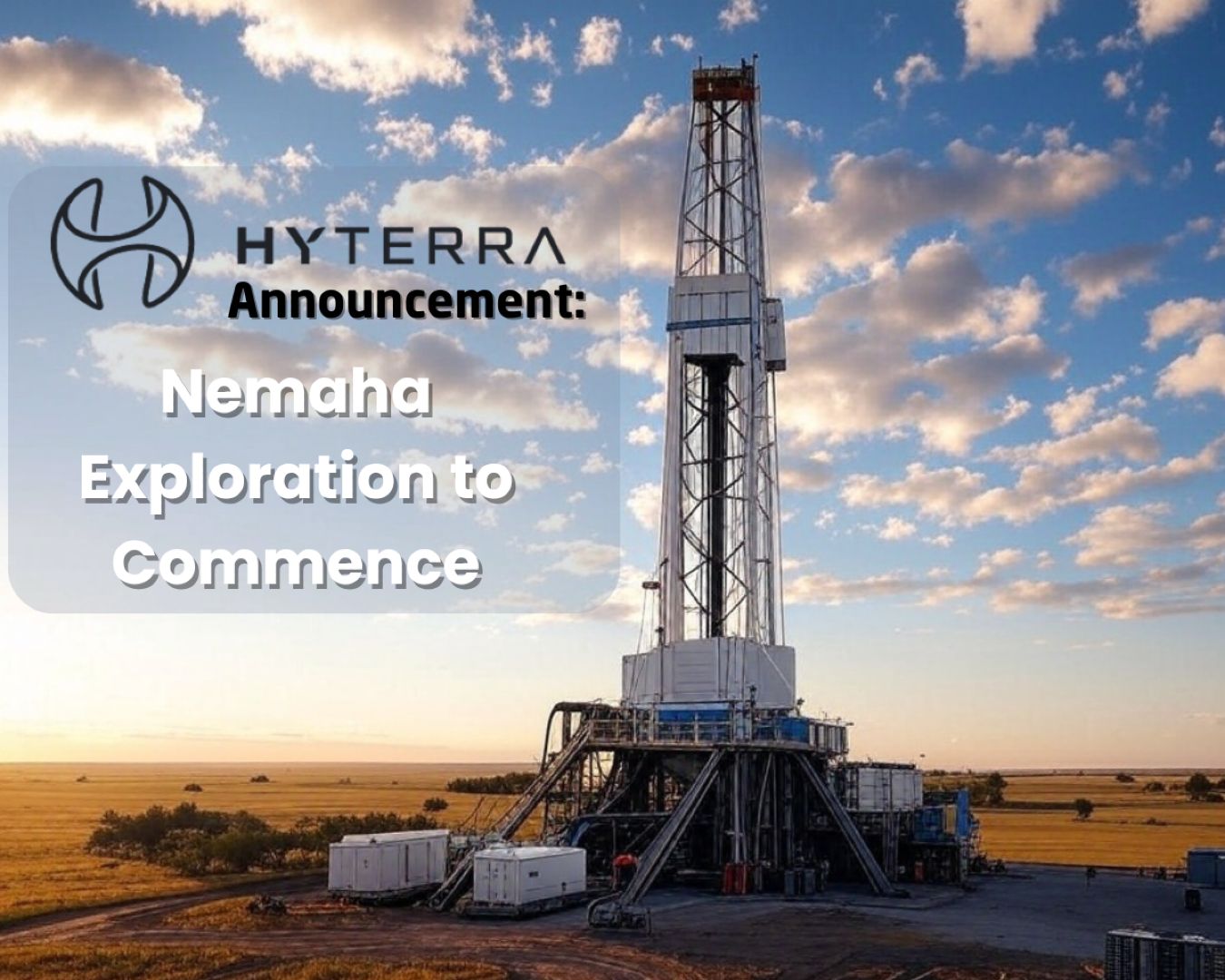
The company has already undertaken geophysical acquisition and drilled three exploration wells across its Kansas acreage. Its technical program also includes production testing at McCoy-1 and ongoing laboratory studies examining hydrogen generation from prospective rock types.
That means the university teams will be working with information generated from active exploration rather than relying entirely on theoretical geological models or laboratory experiments.
HyTerra CEO Riley Kemp said the company has accumulated a substantial dataset through geophysics, drilling, sampling and production testing. The research collaboration will allow university specialists to examine that information independently while HyTerra compares their findings with its own technical work.
The three university teams will share US$250,000 in research funding provided through Renaissance Philanthropy’s Chimaera Fund, with support from Builders Vision.
The research is expected to run over the next 12 months, and the findings are ultimately intended to be published openly.
That structure gives the program two distinct objectives.
For HyTerra, the immediate benefit is additional technical interpretation of its Kansas exploration information and early access to findings that could potentially improve prospect ranking and portfolio evaluation.
For the wider natural hydrogen sector, the eventual open publication provides an opportunity to expand the relatively limited body of publicly available research based on real exploration wells, samples and subsurface datasets.
One potentially important research area is the use of conventional wireline logs.
If researchers can identify repeatable signatures associated with hydrogen-generating or hydrogen-bearing intervals, existing subsurface datasets could potentially become more useful for screening prospective areas. The current program is designed to investigate that possibility rather than establish that such a diagnostic method already exists.
The Mid-Continent Rift rock studies address another part of the exploration model: hydrogen source potential.
HyTerra’s researchers will examine different rock types and the rates at which they may generate hydrogen, information that could help distinguish geological settings capable of ongoing hydrogen generation from areas where favourable structural architecture exists but source potential is weaker.
Combining those results with well, geochemical and geophysical information could ultimately help HyTerra refine how it evaluates opportunities across its portfolio.
Full press release can be found here.