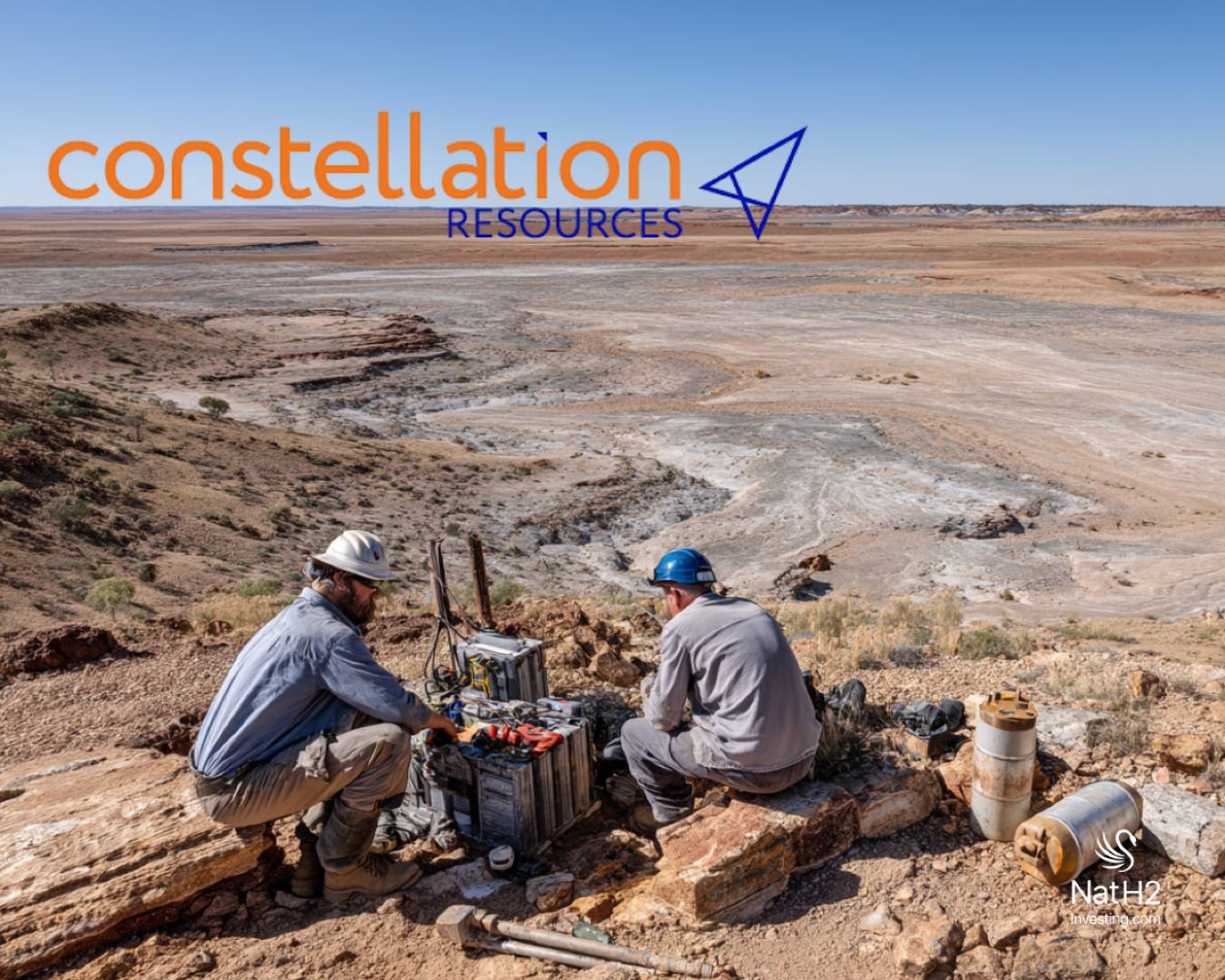
Constellation Resources Reports High Methane and Helium Readings from Historic Drillhole in Western Australia
Constellation Resources has reported repeated high methane and helium concentrations from a historic drillhole within its newly awarded SPA-0143 application area in the Edmund-Collier Basin of Western Australia.
The company stated that gas samples collected over an eight-month period from venting at drillhole WHRD021 returned methane concentrations as high as 97% and helium values up to 0.24% after air correction. The hole was originally drilled in 2012 for iron exploration and remains open today, with repeated gas venting interpreted as possible evidence of an active or recharging subsurface gas system rather than a finite trapped accumulation.
The announcement builds on earlier CSIRO work examining drill core from across the basin. According to Constellation, WHRD021 returned the highest combined hydrogen, methane, helium, and ethane readings within the CSIRO dataset analysed from the region.
Geologically, the hole intersected Proterozoic sandstones, vuggy dolomites, shales, and dolerites situated near deep crustal fault systems and radiogenic basement rocks. The company believes these settings may provide the ingredients for hydrogen, helium, and hydrocarbon generation, migration, trapping, and long-term preservation.
Constellation also highlighted a historical 1977 AMOCO percussion hole in the adjacent SPA-0118 area, where drilling reportedly encountered combustible gas at roughly 300 metres depth and triggered a surface ignition event. The company sees this as additional evidence supporting the presence of a broader basin-scale gas system.
The project area benefits from existing regional infrastructure, including proximity to the Goldfields Gas Pipeline, which the company says may support future commercialization pathways.
Constellation plans additional soil gas surveys, collar gas sampling, isotopic analysis, and laboratory work aimed at better understanding the origin of the gases and evaluating whether the methane is biogenic, thermogenic, or potentially linked to hydrogen conversion processes.
The full press release can be found here.