QIMC Reports Peak 10.77% Hydrogen Mud-Gas Reading from Step-Out Hole at West Advocate
QIMC has reported its highest hydrogen mud-gas readings to date from DDH-26-03 at the West Advocate project in Nova Scotia. The hole was drilled approximately 2.5 km along the Cobequid-Chedabucto structural corridor from the company’s earlier DDH-26-01 and DDH-26-02 holes, making it the first lateral step-out test of the system.
A total of 102 IsoJar mud-gas samples were collected between 473 m and 932 m. The dataset returned a peak hydrogen reading of 10.77% at 848 m, with five readings of 5% or higher over a 69 m interval between 779 m and 848 m. Three of those readings exceeded 7% within a tighter 33 m sub-interval.
The strongest results are hosted in vuggy, magnetite- and pyrrhotite-bearing polymictic conglomerate, which QIMC interprets as a structurally enhanced interval with potential permeability for hydrogen migration. Methane and CO₂ were reported at or below detection across the anomaly interval, which the company interprets as consistent with a natural hydrogen system rather than a conventional thermogenic gas system.
The result is significant because it was recorded 2.5 km from the earlier drill locations and at materially higher hydrogen concentrations than previously reported at West Advocate. QIMC interprets this as support for potential lateral continuity along the structural corridor, although no flow testing, resource estimate, or commercial assessment has yet been completed.
The company has now remobilized to DDH-26-02 to deepen the hole toward approximately 900 m, targeting the same depth window that returned percent-level hydrogen readings in DDH-26-03. Additional holes are planned at Bennett Hill, approximately 12.5 km along the Cobequid Fault Zone, where prior soil-gas work identified a continuous hydrogen anomaly.
Full press release is attached:
Montréal, Québec--(Newsfile Corp. - May 20, 2026) - Québec Innovative Materials Corp. (CSE: QIMC) (OTCQB: QIMCF) (FSE: 7FJ) ("QIMC" or the "Company") is pleased to report mud-gas results from DDH-26-03 at its West-Advocate natural hydrogen exploration project in Cumberland County, Nova Scotia. QIMC-26-03 returned the highest H₂ mud-gas readings recorded to date on the West-Advocate property and represents the Company's first lateral step-out test of the H₂ system, drilled approximately 2.5 kilometres along the Cobequid-Chedabucto structural corridor from previously reported DDH-26-01 and DDH-26-02. The intersection of substantially higher-grade percent-level H₂ readings 2.5 km from the prior drill locations supports the interpretation that the West-Advocate hydrogen system may exhibit lateral continuity along the structural corridor rather than being confined to a localized anomaly. The hole was completed to a final logged depth of 932 metres. A total of 102 IsoJar headspace mud-gas samples were collected over the 473-932 m interval. The dataset returns a peak reading of 10.77% H₂ at 848 m — the highest mud-gas H₂ value recorded to date on the West-Advocate property — along with five stacked percent-level readings ≥5% H₂ in a 69-metre interval (5.10% at 779 m, 5.10% at 806 m, 8.87% at 815 m, 7.29% at 818 m, and 10.77% at 848 m), three readings ≥7% in a tighter 33-metre sub-interval (815-848 m), and a separate elevated reading of 3.42% at 668 m. All five ≥5% H₂ readings are hosted within vuggy, magnetite and pyrrhotite-bearing polymictic conglomerate. Co-collected gas samples returned methane (CH₄) and carbon dioxide (CO2) at or below detection limit across the entire anomaly interval, a gas signature interpreted by the Company as consistent with a natural-hydrogen system and not typical of conventional thermogenic hydrocarbon gas systems.
Highlights
- Highest H₂ mud-gas readings recorded to date on the West-Advocate property: 10.77% H₂ at 848 m, with five stacked readings ≥5% H₂ in a 69-metre interval (5.10% at 779 m, 5.10% at 806 m, 8.87% at 815 m, 7.29% at 818 m, 10.77% at 848 m) — all hosted within vuggy, fractured polymictic conglomerate. An additional discrete elevated reading of 3.42% H₂ was recorded at 668 m.
- Lateral step-out result: Hole 3 drilled approximately 2.5 km along the Cobequid-Chedabucto structural corridor from DDH-26-01 and DDH-26-02, and returned percent-level H₂ readings substantially higher than the peak water headspace value previously reported from DDH-26-02 (8,249 ppmV / 0.82% at 434 m, March 19, 2026). The result supports the interpretation that the H₂ system may extend laterally along the structural corridor rather than a localized anomaly.
- Nearly continuous H₂ mud-gas anomaly from 473 m to 932 m: of 102 IsoJar mud samples, 26 readings exceed 1% H₂, 7 exceed 3%, 5 exceed 5%, 3 exceed 7%, and 1 exceeds 10% by volume. The full-dataset calibration replaces the prior set of field-detector readings (which included multiple sensor over-range events) with quantified concentrations across the entire profile.
- Co-collected gas samples returned CH₄ at or below detection (lower than 0.1%) and CO2 at detection limit across the anomaly interval — a gas signature interpreted by the Company as consistent with a natural-hydrogen system and not consistent with thermogenic gas.
- Mud-gas readings were acquired during drilling using the Company's RKI Eagle 2 instruments (initial LEL-range sensor through 485 m, upgraded thermal-conductivity sensor 0-100% v/v for the balance of the hole), with IsoJar headspace samples co-collected at ≌3 m intervals.
- Hole completed to 932 m TD and approximately 100% recovery throughout.
- Lithology is consistent with the targeted fault-and-fracture-controlled architecture of the R2G2™ exploration model: cataclastic siltstones with repeated mud-seam fault gouges in the upper hole, transitioning to vuggy, magnetite and sulphide-bearing polymictic conglomerate at depth with characteristic "poker-chip" fracture style perpendicular to core axis — the same interval hosting the percent-level H₂ readings.
- All field readings have been independently verified by Prof. Marc Richer-Laflèche, P.Geo., of INRS, who worked on the R2G2™ model and is the independent scientific analyst for the 2026 West-Advocate programme. Independent commentary appears below.
CEO Commentary
John Karagiannidis, Chief Executive Officer of QIMC, commented: "DDH-26-03 delivers QIMC's highest H₂ mud-gas readings to date on the West-Advocate property, a 10.77% H₂ reading at 848 metres, with five stacked percent-level readings between 5.10% and 10.77% in a 69-metre interval, and three readings above 7% in just 33 metres. DDH-26-03 was a deliberate 2.5-kilometre lateral step-out along the Cobequid-Chedabucto structural corridor from Holes DDH-26-01 and DDH-26-02; recording substantially higher concentrations 2.5 km from the prior drill locations suggests this is a structurally extensive hydrogen-bearing system rather than a localized anomaly. The double-digit peak is the headline number, but the more important findings, in our view, are the apparent lateral continuity observed over a 2.5-kilometre scale and the near absence of methane and CO2 across the entire anomaly interval, a gas signature that we interpret as consistent with a natural-hydrogen system rather than a thermogenic gas pocket."
Selected H₂ Mud-Gas Field Readings - QIMC DDH-26-03
Depth (m) | H₂ reading | Host Lithology | Status / Instrument668 | 3.42% | Interbedded sandstone / argillite | Discrete elevated zone above main %-level cluster
779 | 5.10% | Polymictic conglomerate (upper) | First reading ≥5% in main cluster
806 | 5.10% | Vuggy polymictic conglomerate |
815 | 8.87% | Vuggy polymictic conglomerate |
818 | 7.29% | Vuggy polymictic conglomerate |
830 | 3.39% | Vuggy polymictic conglomerate | Intermediate reading between %-level peaks
848 | 10.77% | Vuggy, pyrrhotite-bearing polymictic conglomerate | Peak value - highest H₂ mud-gas reading recorded to date on the West-Advocate property
Table shows the seven readings ≥3% H₂ from the 102-sample IsoJar dataset covering 473-932 m. The five ≥5% H₂ readings (highlighted) sit within a 69-metre interval (779-848 m) hosted in vuggy polymictic conglomerate; the two 3-5% readings (668 m and 830 m) are intermediate elevated readings.
Figure 1 - H₂ Profile vs. Depth, QIMC DDH-26-03
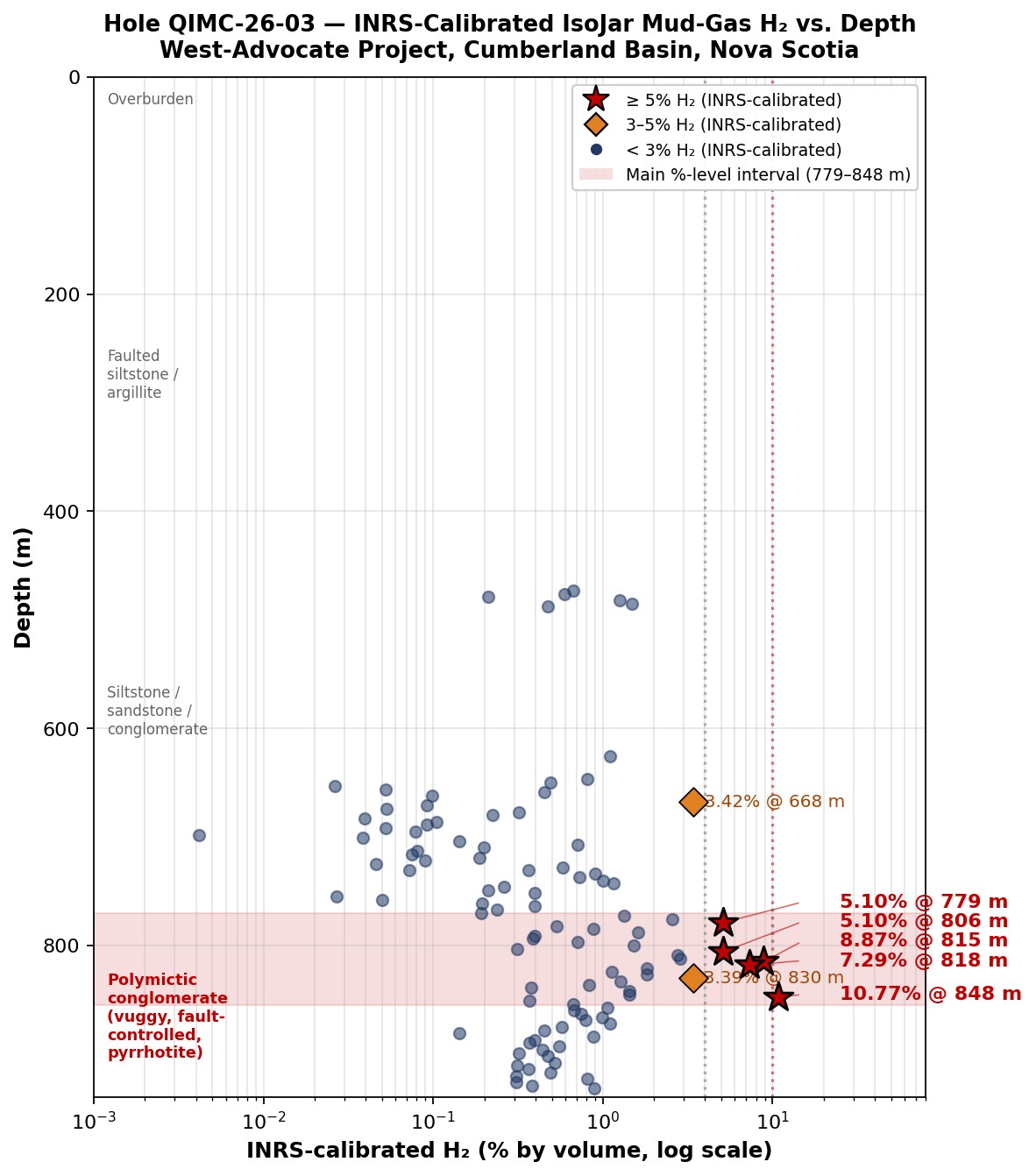
Across the 102 IsoJar samples collected from the 473-932 m interval, co-measured methane (CH₄) returned at or below detection limit (maximum 0.1%) and carbon dioxide (CO2) returned at or below detection throughout. The presence of percent-level H₂ (up to 10.77% by volume) in a gas mixture demonstrably free of methane and CO2 is consistent with an abiogenic hydrogen interpretation, typical of crustal water-rock reactions such as serpentinization of ultramafic protoliths and radiolysis of formation water — and is not typically characteristic of conventional thermogenic hydrocarbon gas systems, which would be dominated by methane and accompanying light hydrocarbons. This signature distinguishes the West-Advocate gas system from conventional petroleum-system gases and supports the structural-source interpretation underpinning the R2G2™ targeting model.
Geological Context
Hole DDH-26-03 was sited within the Cobequid-Chedabucto Fault Zone ("CCFZ"), a >300 km crustal-scale shear corridor inherited from the Avalon-Meguma terrane suture and the central structural element of the Company's Reactivated Rift and Graben Geostructure (R2G2™) exploration model. The model targets fault-and-fracture systems interpreted to operate as advective pathways for deep-sourced hydrogen migration and shallow trapping in fracture-porous sedimentary facies.
DDH-26-03 was drilled approximately 2.5 kilometres along the structural corridor from previously reported Holes DDH-26-01 and DDH-26-02, and represents the Company's first lateral step-out test of the West-Advocate H₂ system. The geometry was designed to test whether the H₂ mud-gas response observed in Holes 1 and 2 extends laterally along the corridor or is confined to a localized structural compartment. The intersection in DDH-26-03 of percent-level H₂ readings to 10.77% substantially above previously reported Hole 2 headspace readings from DDH-26-02 (0.82% at 434 m, reported March 19, 2026) — supports the interpretation that West-Advocate may represent a structurally-controlled natural-hydrogen system exhibiting potential lateral continuity at the 2.5-km scale rather than as a localized anomaly. Hole 3 also extends the depth penetration of the property by approximately 220 metres relative to DDH-26-01.
Logged lithology in DDH-26-03 supports the targeting thesis. The upper section (3-49.7 m) is a fault-disrupted fine-grained siltstone with repeated mud-seam fault gouges and brecciated intervals. The mid-hole interval is a layered siltstone-argillite-sandstone package punctuated by sheared fault breccias, including a discrete 3.42% H₂ reading at 668 m above the main %-level cluster. From approximately 780 m to total depth, the hole transitions into a magnetic, pyrrhotite-bearing polymictic conglomerate exhibiting widespread vuggy texture and "poker-chip" fracturing perpendicular to core axis — a fabric consistent with structurally-enhanced secondary porosity. All five readings ≥5% H₂ (5.10% at 779 m, 5.10% at 806 m, 8.87% at 815 m, 7.29% at 818 m, and 10.77% at 848 m) were recorded within this conglomerate package, clustered in a 69-metre interval that the Company interprets as a hydrogen-bearing interval. Three of these readings (815, 818 and 848 m) cluster within a tighter 33-metre sub-interval, all returning ≥7% H₂.
Independent Scientific Commentary — Prof. Marc Richer-Laflèche, P.Geo. (INRS)
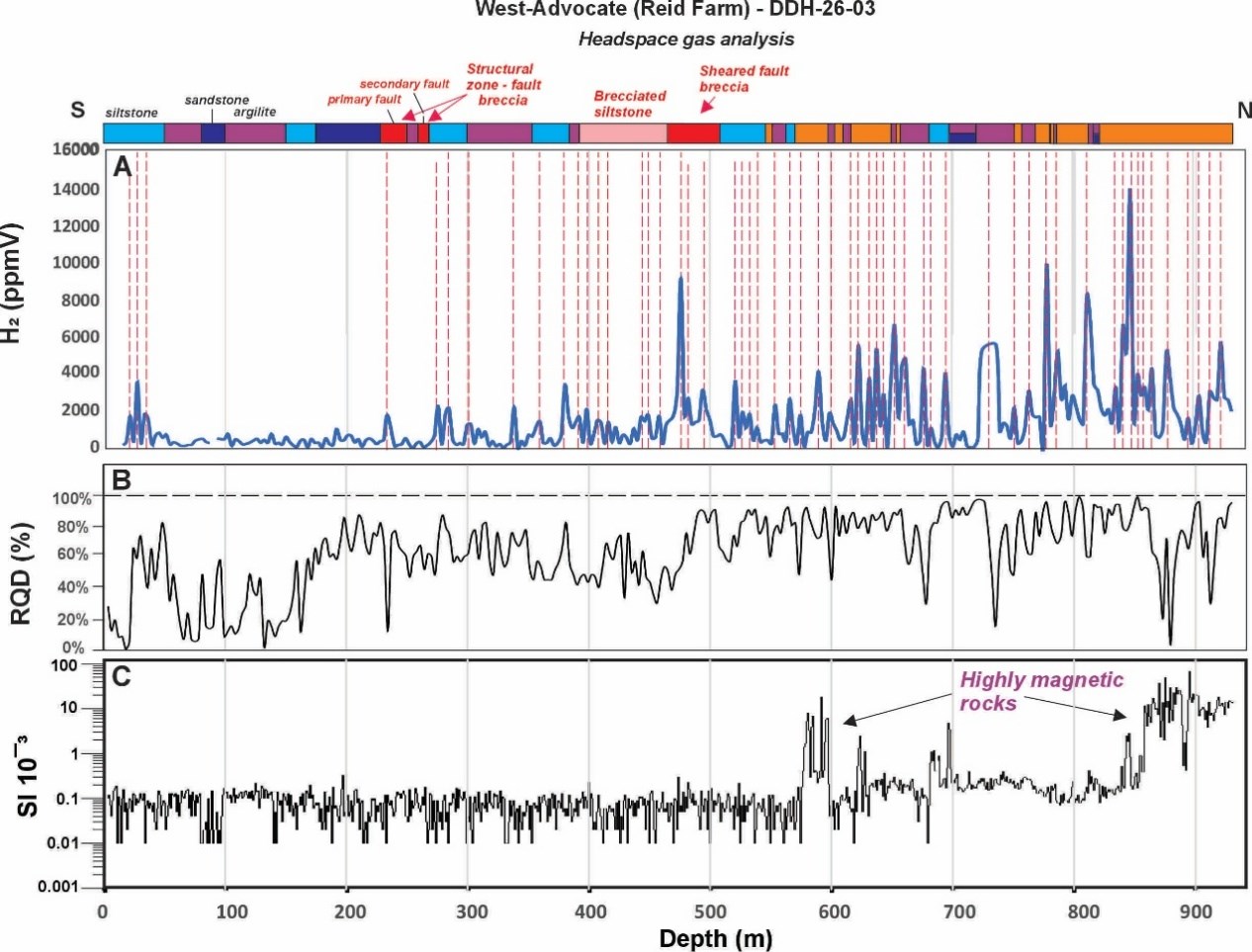
Data from drill hole DDH-26-03 provide key insights for natural hydrogen exploration in the West Advocate area (Nova Scotia). The borehole reveals high H₂ concentrations (ppmV) in both water and drilling-mud headspace, with values that increase with depth and toward the magnetic anomalies mapped on the Government of Nova Scotia's Cobequid Highlands aeromagnetic survey. The strongest hydrogen anomalies occur within variably fractured conglomerates of the Horton Group (Fig. 2b). These units display elevated magnetic susceptibility, consistent with the presence of magnetite fragments and, locally, pyrrhotite within the fractured conglomeratic matrix. Spatially, a clear correlation emerges between magnetite-rich conglomerates and the highest H₂ concentrations measured in DDH-26-03 (Fig. 2c). This association may reflect a genetic link between hydrogen and magnetite, potentially through redox reactions involving Fe(II)-Fe(III) mineral phases, and/or a connection to deep magmatic sources responsible for the observed metasomatism.
The geological context of this sector of the Cobequid Highlands suggests a complex interplay between a major deformation corridors of the Cobequid-Chedabucto Fault Zone (CCFZ), a permeable, competent, fractured sedimentary rocks, and magnetite- and sulphide-bearing conglomerates within a sedimento-plutonic environment. Together, these features point to the possibility of a fossil hydrothermal system with affinities to intrusion-related IOCG-type mineralization. Notably, several Late Carboniferous IOCG-like systems are already recognized along the CCFZ in Nova Scotia, including the Londonderry and South Manchester iron deposits, as well as the Copper Lake and Mount Thom (Cu-Au-Co) occurrences (Belperio, 2007; MacHattie & O'Reilly, 2008).
Hole 2 (DDH-26-02) deepening to ≌900 m - active
Following the demonstration of percent-level H₂ readings in the 806-848 m depth window of DDH-26-03, the Company has remobilized the drill rig to DDH-26-02, which had previously been paused at approximately 500 m due to spring thaw conditions, with the Company noting at that time that elevated H₂ at hole end indicated the system remained open at depth. Hole 2 is now being extended to a planned final depth of approximately 900 metres in order to test the same depth window that returned the percent-level readings in QIMC-26-03, at the Hole 2 collar location.
Mud-gas sampling on the deepened section of Hole 2 has already commenced, using the same upgraded RKI Eagle 2 (TCD, 0-100% v/v H₂) instrument, IsoJar mud sampling at approximately 3-metre intervals, and field QA/QC protocols applied to DDH26-03. The Company anticipates reporting results from the deepened section of Hole 2 in a subsequent news release once drilling and sampling are complete.
Bennett Hill (East Advocate) — Holes 4 and 5 next, ≌12.5 km along the Cobequid Fault Zone
The Company's next two boreholes of the 2026 exploration programme — referred to here as DDH-26-04 and DDH-26-05, and constituting the first two holes of the separately-permitted Bennett Hill Phase 1 three-hole programme, will be drilled at the Bennett Hill Project in the East Advocate area, located approximately 12.5 km along the Cobequid Fault Zone from the QIMC-26-01 / -02 / -03 cluster at West-Advocate. Drill targets at Bennett Hill were defined through the Company's 2025 soil-gas campaign, which delineated a nearly continuous 4-km anomalous line along Bennett Hill Road with mean H₂ of 623 ppm and a peak of 2,247 ppm (47 samples; reported September 3, 2025).
In parallel, an expanded soil-gas field programme has commenced in the extension of the Bennett Hill area, building on the methodology and results of the 2025 campaign. The current programme extends the surveyed footprint farther along the Cobequid Fault corridor and is designed to refine drill-target definition. The percent-level H₂ readings recorded at depth in QIMC-26-03, within the structural setting independently predicted by surface soil-gas and structural mapping, are interpreted by the Company as field-scale support for the relationship and repeatability between surface soil-gas anomalies and subsurface hydrogen accumulations, providing preliminary support for the targeting workflow being applied to Bennett Hill.
Programme outlook beyond Bennett Hill
Following completion of DDH-26-02 deepening, Bennett Hill DDH-26-04 and DDH-26-05, and the INRS analyses for QIMC-26-03, the Company will integrate the combined dataset — surface soil-gas, structural mapping, three West-Advocate boreholes and the forthcoming two Bennett Hill boreholes to prioritize subsequent drilling targets. QIMC continues to advance permitting and technical review for the Little Forks and SpringHill areas as the next priority within its district-scale Nova Scotia natural-hydrogen exploration strategy.
Community Engagement and Community Liaison Committee
QIMC sincerely thanks the residents and community members who attended the well-attended community open house held in West Advocate on May 11, 2026, and acknowledges the constructive discussion and feedback received on that occasion. The Company values the time, perspectives and questions shared by attendees.
As part of the Company's ongoing community engagement strategy, which was already announced, QIMC is proceeding with the establishment of a Community Liaison Committee to provide a structured, advisory forum for transparent two-way communication, community feedback, and constructive dialogue related to the Company's exploration activities in the area. The perspectives shared by community members at the May 11 open house will help inform the Committee's structure, composition, and operating priorities as it is established. QIMC remains committed to transparent, two-way communication with the Advocate community as exploration work continues at West Advocate, Bennett Hill and across the Company's district-scale Nova Scotia natural-hydrogen programme.
About QIMC
Québec Innovative Materials Corp. is a North American exploration and development company advancing a portfolio of natural hydrogen and critical mineral projects. The Company is advancing its district-scale hydrogen exploration model across Québec, Ontario, Nova Scotia and Minnesota, leveraging its proprietary R2G2™ framework.
QIMC is committed to responsible exploration, technical innovation and sustainable development, with the objective of supporting clean energy and decarbonization initiatives.
For Further Information:
QUÉBEC INNOVATIVE MATERIALS CORP.
John Karagiannidis
President & Chief Executive Officer
Email: info@qimaterials.com
Tel: +1 514-726-7058
Disclaimer
Neither the Canadian Securities Exchange nor its Regulation Services Provider accepts responsibility for the adequacy or accuracy of this release.
Forward-Looking Statements
This news release contains "forward-looking information" and "forward-looking statements" within the meaning of applicable Canadian securities legislation. Forward-looking statements include, without limitation, statements regarding the interpretation of drill results, the expected timing and outcome of laboratory analyses, the geological model underpinning the West-Advocate project, the inferred origin (abiogenic / thermogenic) of the gas reported herein, the inferred lateral continuity of the H₂ system across the structural corridor, plans for additional drilling, and the Company's exploration and business strategy. These statements are based on assumptions and expectations that QIMC believes are reasonable as of the date hereof, but they are subject to known and unknown risks and uncertainties — including but not limited to commodity-price volatility, exploration risk, the risk that laboratory results may not confirm field readings, regulatory and permitting risk, financing risk, and general market and operational conditions — which could cause actual results to differ materially. Readers are cautioned not to place undue reliance on forward-looking statements. The Company undertakes no obligation to update forward-looking statements except as required by law.
Mud-gas readings reported in this news release are based on co-collected IsoJar headspace samples taken at approximately 3-metre intervals during drilling of DDH-26-03 and subsequently calibrated by Prof. Marc Richer-Laflèche, P.Geo. of INRS against a higher-precision laboratory reference instrument. The full-dataset calibration was applied to all 102 IsoJar samples and replaces the prior set of in-field detector readings (which included multiple sensor over-range events) as the reported values throughout this news release. These measurements are indicative of the presence of gas-bearing intervals encountered during drilling but should not be taken as representative of in-situ reservoir gas composition, gas-in-place volumes, sustained-rate flow potential, or any commercial-quantity hydrogen resource. No flow testing has been conducted. References to "highest H₂ mud-gas readings to date" and "peak 10.77% H₂" are made with reference to the Company's own historical record on the West-Advocate property and do not imply comparison to any third-party project or dataset. All values reported are INRS-calibrated by Prof. Marc Richer-Laflèche, P.Geo. against a higher-precision laboratory reference. H₂ values are field mud-gas concentrations and are indicative of gas-bearing intervals encountered during drilling; they are not equivalent to reservoir composition at in-situ conditions. The Company has not completed any economic evaluation, resource estimate, or commercial flow assessment for the West-Advocate project.
Mud-gas readings during drilling were acquired at the rig's gas-trap return line using RKI Instruments Eagle 2 portable H2 and Ga5000 multi-gas detectors paired with IsoJar headspace samples collected at approximately 3-metre intervals over the 473-932 m interval. The initial detector unit deployed at spud was configured with an LEL-range H₂ sensor (calibrated full-scale response equivalent to approximately 4% H₂ by volume / 100% LEL).
Calibration is performed using aluminum foil bags filled with certified gas standards because this method reproduces the exact sampling conditions used during the routine measurements. By introducing the calibration gas through the same recirculation pathway as our field samples, we ensure that the instrument accounts for any effects related to flow rate, tubing, bag material or internal dilution. This approach provides a more representative and reliable calibration, improves quantitative accuracy, and ensures that the GA5000 responds consistently to both calibration gases and real samples. Bump tests were carried out and compiled for all working shifts in the mobile laboratory. Analytical blanks (atmospheric air) were made to check the proper functioning of the detectors.
At 485 m, that sensor recorded the first sustained over-range condition of the hole. To preserve quantitative data integrity for the balance of the hole, the Company procured and deployed a second Eagle 2 unit fitted with a thermal-conductivity (TCD) H₂ sensor calibrated 0-100% by volume, used for the remainder of DDH-26-03 under standard field QA/QC protocols including pre-shift calibration against certified H₂-in-N₂ span gas. IsoJar mud samples were collected for laboratory verification at INRS.