Michigan Commits $7.5 Million to Geologic Hydrogen Exploration, Research and Test Drilling
Michigan is putting $7.5 million of state funding behind geologic hydrogen, moving from policy preparation toward practical exploration, subsurface research and test drilling.
The Michigan Infrastructure Office announced the investment through the Make It in Michigan Competitiveness Fund, describing geologic hydrogen as a potential new source of economic growth, lower-cost energy and industrial decarbonization for the state.
The funding follows Executive Directive 2026-1, signed by Governor Gretchen Whitmer in January, which established the Michigan Geologic Hydrogen Exploration and Preparedness Initiative.
That directive set out a statewide approach covering exploration, regulation, workforce development, infrastructure, environmental evaluation and economic planning.
The new funding now provides capital to begin answering the geological questions at the centre of that strategy.
Michigan plans to support mapping and subsurface characterization, using decades of state geological records to identify areas where naturally occurring hydrogen may be generated, migrating or accumulating underground.
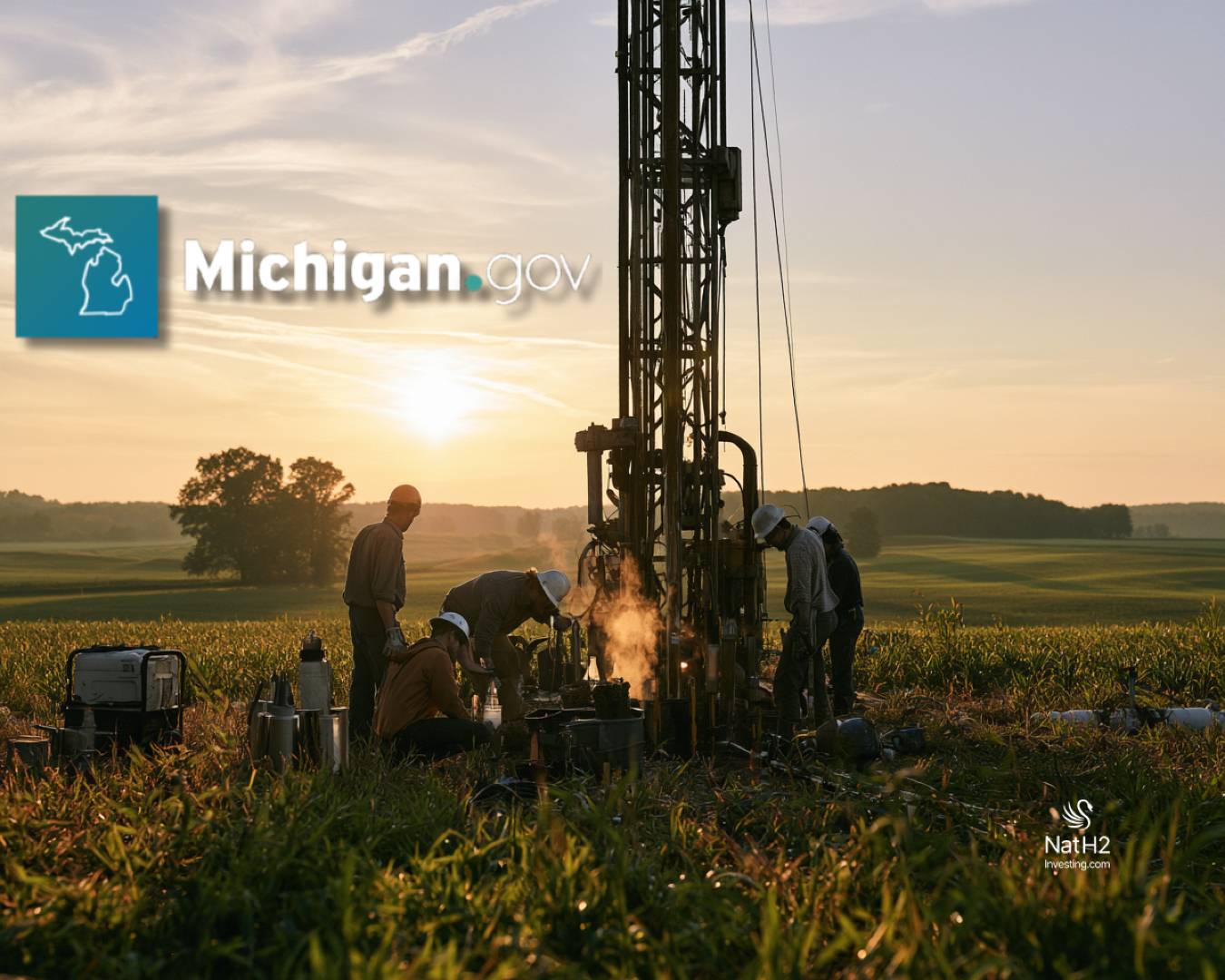
More significantly, the program includes funding for test wells designed to determine whether hydrogen is present in meaningful quantities.
That represents an important progression from geological modelling and surface research toward direct subsurface validation.
Research will involve collaboration with the U.S. Department of Energy, four national laboratories, universities, research institutions and private-sector partners, creating a broader scientific effort around Michigan’s potential hydrogen systems.
Part of the $7.5 million will also be reserved as matching capital to pursue additional federal funding from the Department of Energy and other agencies. If successful, that could allow the state investment to support a substantially larger exploration and research program.
Michigan believes its geology could make it one of the more prospective regions in the United States for geologic hydrogen, although the state is emphasizing that the work remains exploratory.
The central questions are still whether meaningful hydrogen accumulations exist, whether they can be safely produced and whether they could ultimately compete economically with manufactured hydrogen and other energy sources.
The initiative is therefore being developed alongside regulatory and environmental preparation rather than treating exploration as a standalone geological exercise.
Public engagement will form another part of the program, including meetings and educational resources as research progresses.
Michigan is also working on the other side of a potential hydrogen market: demand.
During 2026, the state’s Office of Future Mobility and Electrification awarded grants supporting hydrogen fueling infrastructure, energy-generation technologies and vehicle applications. That creates an emerging demand-side strategy alongside the new supply-side effort to investigate indigenous geologic hydrogen.
Full press release can be found here.