Kura Dynamics Raises $5 Million to Advance Stimulated Geologic Hydrogen Technology
Christchurch deep-tech start-up Kura Dynamics has secured $5 million in pre-seed funding to advance a technology platform aimed at making stimulated geologic hydrogen more predictable and potentially scalable, moving the company from laboratory development toward field commercialization.
Founded in January by Dr Chris Oze and Peter Joynt, Kura is taking a different approach from natural hydrogen companies primarily focused on locating underground accumulations. Instead, the company is developing technology intended to understand, control and accelerate the geochemical reactions that generate hydrogen when water interacts with iron-rich rocks underground.
The underlying process occurs naturally as iron-bearing minerals react with water, removing oxygen and releasing hydrogen. While natural hydrogen explorers typically search for gas that has already been generated, migrated and accumulated, stimulated geologic hydrogen seeks to actively enhance hydrogen production within suitable rock formations.
That distinction puts Kura in an emerging part of the geologic hydrogen sector where the central technical challenge is not simply finding hydrogen, but determining whether underground reactions can be managed reliably enough to produce it at commercially meaningful rates.
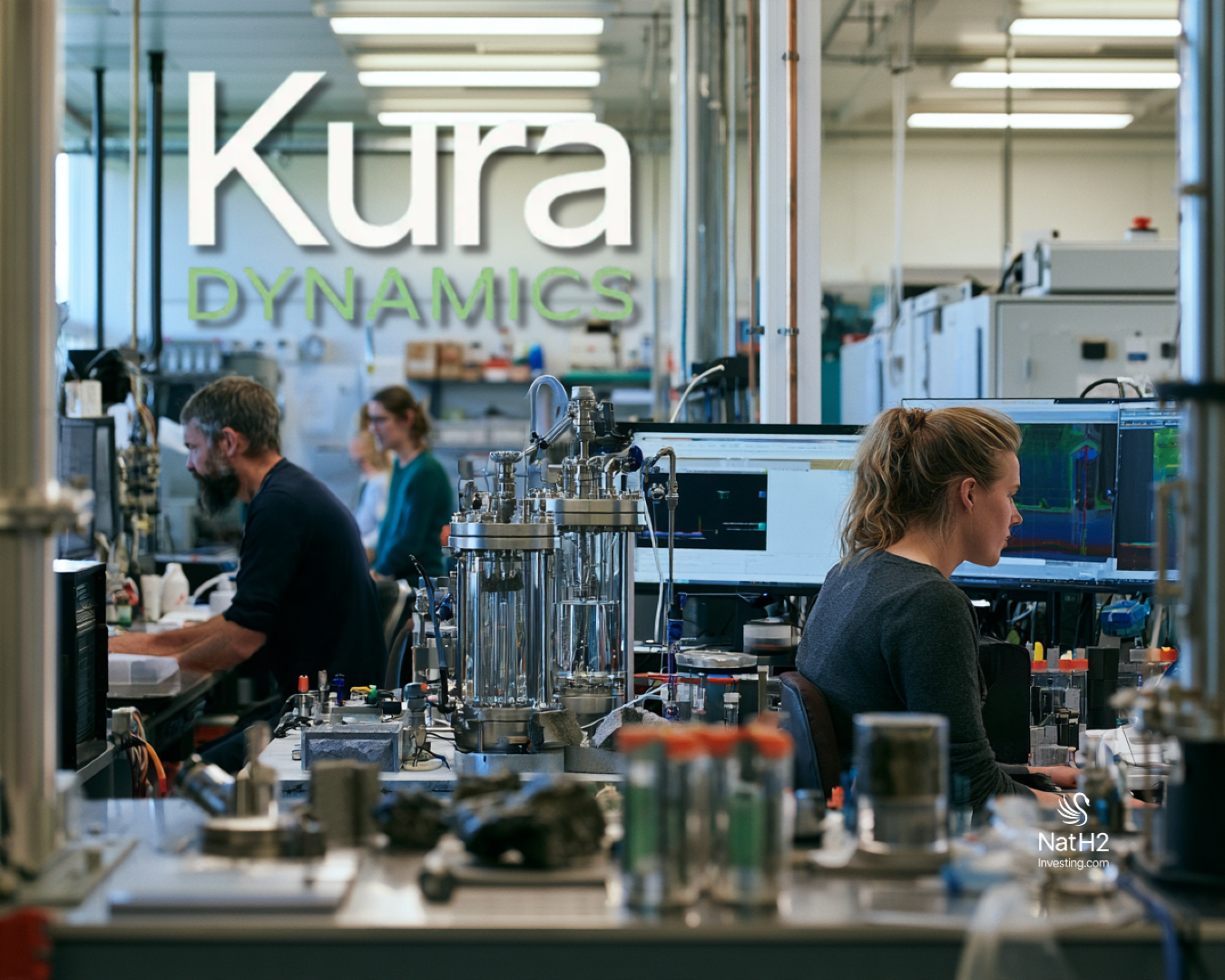
Kura says its approach combines real-world chemistry expertise, proprietary datasets and supercomputing to accelerate development of what it describes as a safe and reliable hydrogen stimulation framework.
Details of the underlying technology remain confidential, but co-founder Peter Joynt said the system centres on using data from geologic hydrogen recovery to actively support decision-making in real time.
The company says it has achieved a small-scale laboratory breakthrough. The new capital will be used to push the technology toward field commercialization, where Kura will need to determine whether results demonstrated under controlled laboratory conditions can be translated into complex subsurface environments.
The $5 million financing was co-led by Global From Day One (GD1) and Motion Capital, which together now own 27% of Kura.
The round was also supported by Outset Ventures, Sir Stephen Tindall's K1W1 and Crown-backed NZ Growth Capital Partners. Kura's broader shareholder group includes Icehouse Ventures, Breakthrough Energy and Elemental Impact.
Kura's founding team brings experience from two established New Zealand geoscience and cleantech businesses.
Joynt spent 14 years at Christchurch geoscience software company Seequent, working in roles ranging from project geologist to prototyping team lead. Seequent developed 3D earth-modelling and geoscience software before being acquired by Bentley Systems in 2021 for US$1.05 billion.
Oze holds a PhD in biogeochemistry from Stanford University and later moved to New Zealand for an academic role at the University of Canterbury. He subsequently co-founded cleantech company Aspiring Materials, where he spent seven years before establishing Kura.
That combination of geochemistry and geoscience technology is reflected in Kura's proposed model.
Rather than treating subsurface hydrogen generation as a static geological process, the company wants to build an intelligence layer capable of interpreting what is occurring underground and helping operators make decisions as hydrogen-generating reactions evolve.
GD1 general partner Aaron Small contrasted that approach with exploration-led natural hydrogen companies, arguing that Kura is attempting to understand subsurface processes sufficiently well to deliberately work with them rather than simply identify locations where hydrogen has already accumulated.
Motion Capital partner Ralph Chang similarly described the company's objective as turning an unpredictable natural reaction between rock and water into a process that can potentially be steered.
If successful, that approach could address one of the central economic questions surrounding stimulated geologic hydrogen.
Conventional manufactured hydrogen requires an external energy input. Electrolysis, for example, uses electricity to split water into hydrogen and oxygen, while other established hydrogen-production routes rely heavily on fossil fuels.
Stimulated geologic hydrogen instead seeks to use naturally reactive geology as part of the production process. The potential attraction is that the chemical energy stored in suitable rocks could contribute to hydrogen generation underground, reducing the amount of external energy required.
But the technical challenge is substantial.
Subsurface formations vary in mineralogy, temperature, permeability, fracture networks, water chemistry and reaction kinetics. Stimulating hydrogen generation is therefore only one part of the problem; developers also need to understand how generated gas moves through the formation, whether it can be collected efficiently and whether production can be sustained at useful rates.
Kura's technology appears aimed at reducing that uncertainty through chemistry, modelling, proprietary data and real-time decision support rather than relying on a single fixed stimulation recipe.
The $5 million raise is notable because it comes at a very early stage. Kura was only established this year and remains pre-commercial, with its reported breakthrough demonstrated at small laboratory scale rather than through a producing field operation.
Full press release can be found here [EXTERNAL].