Gold Hydrogen’s Ramsay 2 Flows Up to 20% Helium, Confirming Reservoir Continuity in South Australia
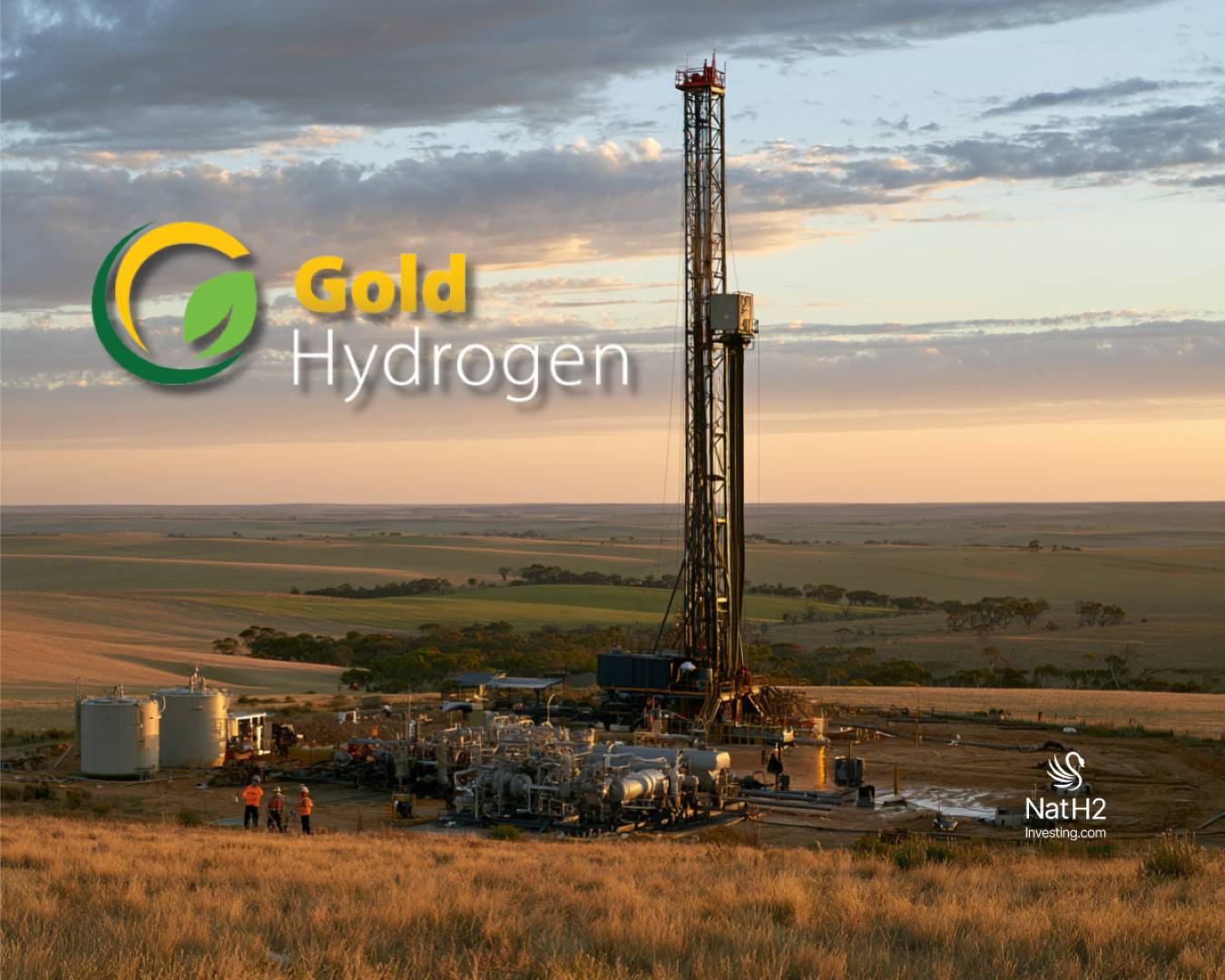
Gold Hydrogen has reported another major step in the appraisal of its Ramsay Project in South Australia, with the Ramsay 2 flow test producing helium at air-corrected concentrations of up to 20% from the Kulpara Dolomite.
More importantly, the second well provides the company’s first dynamic evidence that the helium-bearing reservoir encountered at Ramsay 1 is not simply an isolated occurrence.
Ramsay 2 sits approximately 500 metres from Ramsay 1, and Gold Hydrogen says comparable helium concentrations, reservoir characteristics and deliverability between the two wells support its interpretation of a laterally continuous helium-bearing system.
Testing focused on the approximately 180-metre gross Kulpara Dolomite interval, Gold Hydrogen’s primary helium target across the Ramsay Project.
A raw gas stream was successfully flowed and separated at surface using the company’s artificial-lift flow-test system. Air-corrected helium concentrations reached 20% at Ramsay 2, compared with a stabilised air-corrected concentration of 19% previously measured at Ramsay 1.
The company also tested the deeper fractured Hiltaba Basement, reporting air-corrected helium concentrations of up to 19% across a 200-metre gross interval. The concentrations are field measurements and remain subject to independent laboratory confirmation.
Reservoir performance was another important part of the results.
Gold Hydrogen reported raw gas rates of up to approximately 128 Mscf/day and helium rates of up to approximately 24.3 Mscf/day from the Kulpara Dolomite. The company said both Ramsay 1 and Ramsay 2 testing remained constrained by installed pump capacity and completion design rather than reservoir deliverability.
The Ramsay reservoir demonstrated productivity of up to approximately 34 barrels/day/psi, which Gold Hydrogen says substantially exceeds the sub-2 barrels/day/psi typical of commercial low-permeability reservoirs.
The improved cased-and-perforated completion at Ramsay 2 also delivered almost three times the ESP pump efficiency achieved during stabilised testing at Ramsay 1.
That is particularly relevant at Ramsay because helium is produced in association with formation water. Improving the efficiency with which that water can be lifted to surface is therefore directly relevant to potential helium deliverability.
Gold Hydrogen plans to carry those lessons into Ramsay 3, where pumping rates are expected to be progressively increased towards approximately 20,000 barrels per day.
The company says the Ramsay 2 program provides an operational bridge between the appraisal work completed so far and the planned scale-up testing at Ramsay 3, while also informing the engineering basis for a potential Ramsay Helium Pilot Project.
An independent Worley assessment previously concluded that a commercial helium development at Ramsay may potentially be viable with as few as two wells, although that remains subject to further technical, commercial and economic evaluation. Gold Hydrogen says the latest Ramsay 2 results provide additional support for the technical assumptions behind that potential development pathway.
Gold Hydrogen currently holds an independent Helium Prospective Resource assessment for the Ramsay Project with a mean estimate of 96 Bcf.
The resource statement included with the announcement gives PEL 687 estimates of 7 Bcf at 1U, 41 Bcf at 2U, a 96 Bcf mean estimate and 243 Bcf at 3U across all prospects and formations. These remain Prospective Resources relating to undiscovered accumulations rather than Contingent Resources or Reserves.
Ramsay 2 adds several pieces of evidence needed to move the project towards a higher level of resource definition: helium has now flowed from two separate locations, comparable concentrations and reservoir characteristics support continuity, and the improved completion has generated zone-specific information for future reservoir modelling and development planning.
Gold Hydrogen expects to assess the booking of maiden Contingent Resources after completing and interpreting the full 2026 flow-testing program, including the planned testing at Ramsay 3.
The company is also considering an accelerated FEED program for a helium-focused development and says commercial discussions are continuing with development partners, including assessment of low-cost pilot options and vendor designs and costings for a modular commercial helium plant.
There is still substantial work ahead.
Gold Hydrogen explicitly cautions that the Ramsay 2 results are interim and do not establish commercially recoverable helium, sustained long-term flow rates or project economics. The field measurements are preliminary, and there is no certainty that Contingent Resources will ultimately be booked or that a pilot project will proceed.
But Ramsay 2 answers an important question left after the first well: Gold Hydrogen has now flowed high-concentration helium from the same Kulpara reservoir at two separate locations roughly half a kilometre apart.
Full press release can be found here.