Gold Hydrogen Reports Strong Ramsay 1 Helium Flow Test and Advances Commercial Development Studies
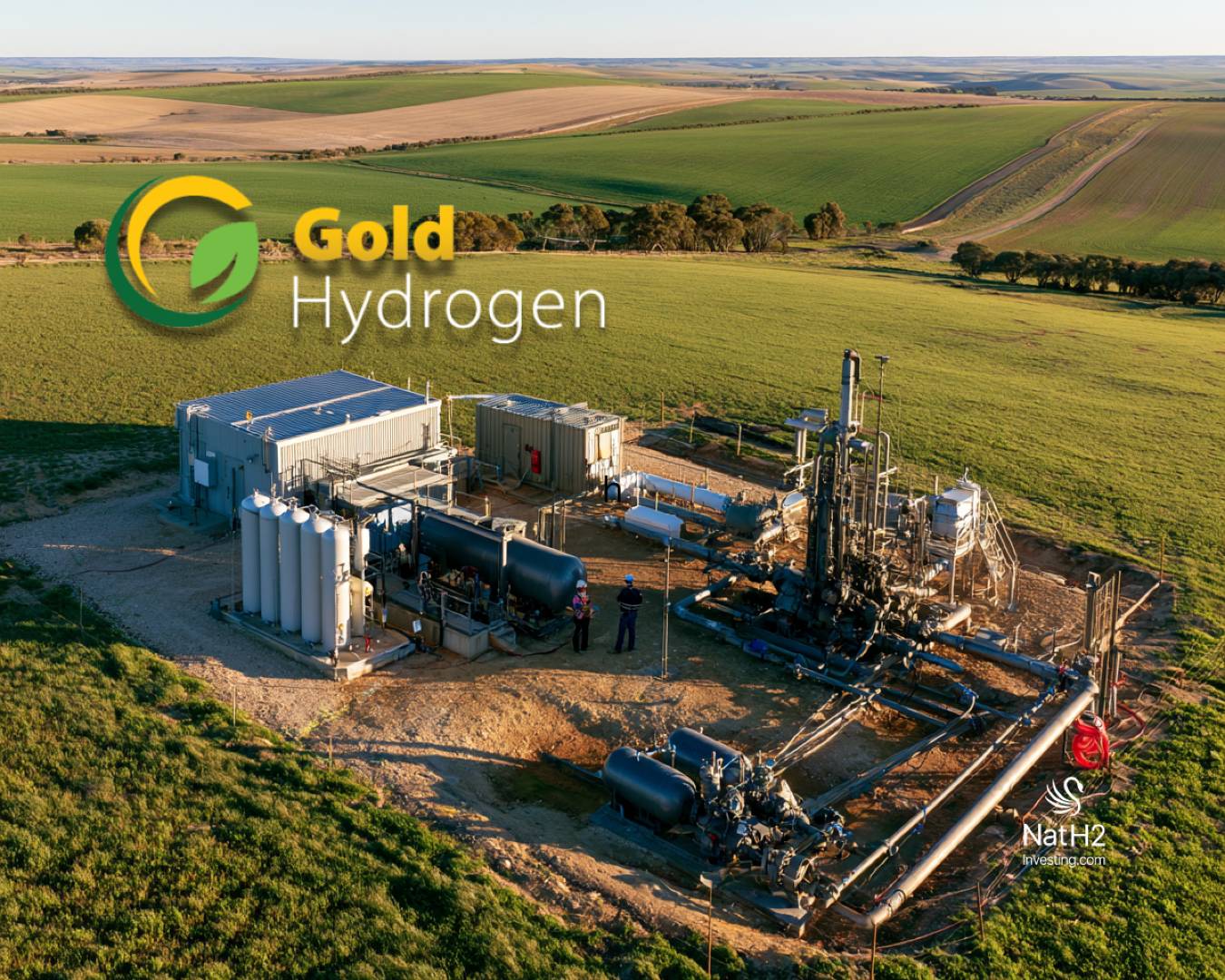
Gold Hydrogen has completed appraisal flow testing at Ramsay 1 on South Australia’s Yorke Peninsula, reporting strong reservoir productivity, sustained high helium concentrations and successful onsite separation, purification and bottling.
The seven-day program tested the Kulpara Dolomite using an electrical submersible pump rated at 2,000 barrels per day. The well reached the pump’s maximum capacity while requiring only around 100 psi of pressure drawdown, indicating that production during the test was constrained by the installed equipment rather than the reservoir itself.
Gold Hydrogen calculated a productivity index of up to approximately 34 barrels per day per psi. The company said this supports its geological interpretation of the Kulpara Dolomite as a connected, high-transmissibility carbonate reservoir with a substantial underlying aquifer.
Air-corrected helium concentrations reached as high as 30% and stabilised at approximately 19% during sustained flow. Raw helium concentrations reached up to 13% and were reportedly continuing to rise when testing concluded. The field measurements remain subject to independent laboratory confirmation, with samples sent to CSIRO and the University of Oxford for compositional and isotopic analysis.
The Ramsay system contains helium dissolved within formation water. Once the water reaches the surface, the gas is separated and processed. During the test, Gold Hydrogen demonstrated the complete sequence of flowing the resource, separating the gas, increasing its helium concentration and capturing the purified product in cylinders.
A single-stage membrane unit supplied by Quantum Technology Corporation increased one raw gas stream from 5.6% helium before air correction to 50.5%. Gold Hydrogen said an additional pressure-swing adsorption stage would be required to reach a commercial specification of approximately 99% helium.
The measured 2026 test produced up to approximately 12.8 Mscf/d of raw gas and 2.4 Mscf/d of helium. Based on the observed reservoir productivity, helium concentration and gas-to-water ratio, the company has modelled a purpose-built well using a 20,000-barrel-per-day pump producing up to 128 Mscf/d of raw gas and 24.3 Mscf/d of helium. These higher rates are modelling outcomes and have not yet been demonstrated through flow testing. The comparison is set out in the table on page four of the announcement.
Ramsay 1 was originally constructed as an exploration well and contains a four-inch slotted liner that limits zonal isolation and the size of downhole equipment. Ramsay 3 has been designed with cemented seven-inch casing and is capable of accommodating the larger pumping system required to test higher production rates.
The results also advance the commercial pathway previously assessed by Worley, which considered development scenarios potentially requiring as few as two helium production wells. Gold Hydrogen now intends to accelerate Front-End Engineering Design for a helium-focused development while continuing to evaluate modular purification and pilot-production options.
The company currently reports a mean prospective helium resource estimate of 96 Bcf across the broader Ramsay Project. Data from the Ramsay 1, Ramsay 2 and Ramsay 3 flow tests, combined with the independent Worley assessment, are expected to support evaluation of a maiden contingent helium resource.
Testing will now move to Ramsay 2 and then Ramsay 3. The upcoming programs will conduct zonal testing across the gas-bearing formations, with specific attention also being given to the natural hydrogen-bearing Parara Limestone.
Full press release can be found here.