Gold Hydrogen Outlines Ramsay Commercialisation Roadmap With Helium and Natural Hydrogen Pilots Targeted for 2027–2028
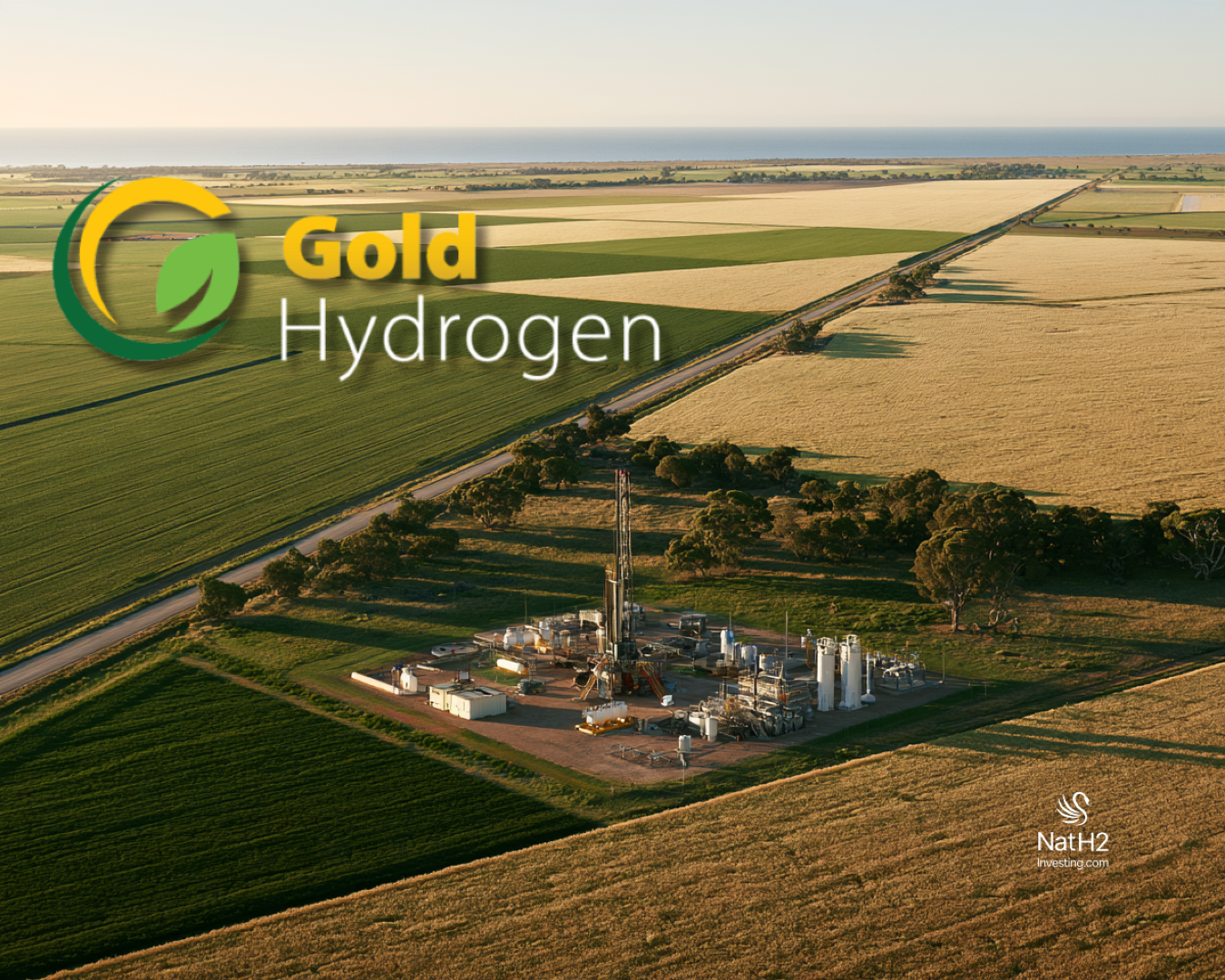
Gold Hydrogen Limited (ASX: GHY) has outlined its next phase of exploration, appraisal and commercial development at the Ramsay Project in South Australia, following a successful drilling and flow testing campaign that recovered natural hydrogen and helium to surface, demonstrated on-site helium purification and confirmed elevated concentrations of helium-3.
In its 2026 Annual General Meeting presentation, the company detailed a development strategy encompassing modular helium production, natural hydrogen-to-power generation, green methanol manufacturing, potential liquid hydrogen exports and further exploration targeting free-gas accumulations.
The immediate priority is the completion of an independent helium Contingent Resource assessment, targeted for November or December 2026, which is expected to underpin decisions regarding pilot development during 2027–2028.
Gold Hydrogen's wholly owned Ramsay Project covers approximately 5,200 km², with a further 69,472 km² under exclusive application, providing a substantial regional footprint for future exploration.
The company has successfully drilled and tested four exploration and appraisal wells, with its 2026 flow testing campaign focusing on Ramsay 1, Ramsay 2 and Ramsay 3.
Helium flowed to surface at all three wells, while natural hydrogen was recovered during testing at Ramsay 2 and Ramsay 3.
The campaign demonstrated continuity of the helium-bearing Kulpara Dolomite reservoir across approximately 2.2 kilometres, providing an important geological foundation for potential multi-well development.
Sustained air-corrected helium concentrations reached approximately 19% at Ramsay 1 and 20% at Ramsay 2, while Ramsay 3 recorded stabilised concentrations of approximately 6.5%, with individual samples reaching 12.6%.
Together, these results produced a project-wide average helium concentration of approximately 15.2%, calculated as the arithmetic average of sustained concentrations across the three wells.
Previous sampling at Ramsay has recorded helium concentrations as high as 36.9% on a corrected basis, placing the project among the higher-concentration helium exploration discoveries reported internationally.
One of the most significant operational achievements was the successful separation, purification and bottling of helium directly at the Ramsay 1 wellsite.
This demonstrated a critical component of the proposed commercial recovery process, in which helium is extracted from formation water, separated from other gases and purified for industrial applications.
At Ramsay 3, peak fluid production rates reached approximately 14,000 barrels per day, with a reported productivity index of approximately 34–40 barrels per day per psi.
The appraisal results support a modelled helium production potential of approximately 37,000 standard cubic feet per day per well, assuming fluid production rates of up to approximately 20,000 barrels per day.
This exceeds the approximately 27,000 standard cubic feet per day identified in an earlier Worley commercial modelling scenario as potentially economically viable.
The 37,000-cubic-foot figure represents modelled productive potential rather than a sustained helium production rate demonstrated during flow testing.
The natural hydrogen results provide a parallel development opportunity.
During drilling at Ramsay 3, Gold Hydrogen recorded hydrogen concentrations of up to 97% on an air-corrected basis, with the company reporting an approximately 78% field-wide average hydrogen concentration.
The hydrogen-bearing Parara Limestone was subsequently flow tested using an electrical submersible pump during October 2026.
Based on appraisal data, Gold Hydrogen has modelled potential natural hydrogen production exceeding 100 kilograms per day per well, including a scenario of approximately 112 kilograms per day using a 500-metre horizontal well.
At 100 kilograms per day, an individual well could theoretically produce approximately 36.5 tonnes of hydrogen annually under continuous operating conditions.
The proposed development concept takes advantage of Ramsay's vertically stacked reservoirs, with the shallower hydrogen-bearing Parara Limestone positioned above the deeper helium-bearing Kulpara Dolomite.
Gold Hydrogen envisages using dual-perforated production wells to recover both gases through shared well infrastructure, followed by surface separation, purification and reinjection of produced formation water.
The initial commercial concept prioritises helium production, with recovered natural hydrogen potentially supplying on-site electricity generation.
This integrated approach could create operational synergies between the two commodities while reducing the need for separate production infrastructure.
Another emerging opportunity is the presence of helium-3, a rare isotope with applications in quantum computing, cryogenics, neutron detection, medical imaging and nuclear fusion research.
Analysis conducted by Oxford University detected helium-3 in all six gas samples collected from Ramsay 1 and Ramsay 2 during the 2026 testing campaign.
The highest argon-corrected concentration reached 1,220 parts per trillion in samples from the Hiltaba Basement at Ramsay 2, approximately 165 times the atmospheric concentration.
Further analysis of Ramsay 3 samples is underway, alongside planned laboratory investigations and assessments of specialist isotope separation technologies.
Helium-3 could provide an additional value stream for the Ramsay Project, although recoverable quantities and commercial separation capabilities have not yet been established.
Gold Hydrogen's commercial helium strategy centres on a modular processing facility, with the initial processing train progressing through final design and procurement activities.
Engineering consultancy Worley has completed commercial modelling and a basis of design for a gaseous helium production system capable of delivering a product with a target purity of 99.999%.
The proposed process incorporates gas-water separation, compression, membrane separation, pressure swing adsorption, catalytic oxidation and final product compression for transportation.
Gold Hydrogen has outlined several potential expansion scenarios based on the modular processing concept.
A two-train configuration could theoretically supply approximately 11% of Australian helium demand, while a five-train configuration would have an indicative nameplate capacity of 31.5 million cubic feet annually, equivalent to approximately 26% of domestic demand.
A longer-term 12-train scenario, incorporating liquefaction capabilities, could potentially address Australia's entire domestic helium requirement while creating export opportunities.
These expansion scenarios are based on vendor design capacities rather than production forecasts, with additional processing trains remaining conceptual and unfunded.
The opportunity is particularly relevant given Australia's dependence on imported helium following the closure of its Darwin helium production facility in December 2023.
Gold Hydrogen sees domestic helium production as an opportunity to strengthen supply security for Australia's medical, scientific and advanced manufacturing industries.
Beyond helium, Gold Hydrogen is progressing a potentially larger natural hydrogen commercialisation pathway through its relationship with Japanese industrial group Mitsubishi Gas Chemical (MGC).
The companies signed a non-binding Memorandum of Understanding in June 2026 to undertake a staged assessment of potential green methanol production on the Yorke Peninsula.
A feasibility study is targeted for the first quarter of 2027, with preliminary modelling suggesting a potential methanol production capacity of approximately 20,000 tonnes annually.
The full presentation can be found here.