Gold Hydrogen Moves to Ramsay 3 for Larger-Scale Natural Hydrogen and Helium Flow Testing
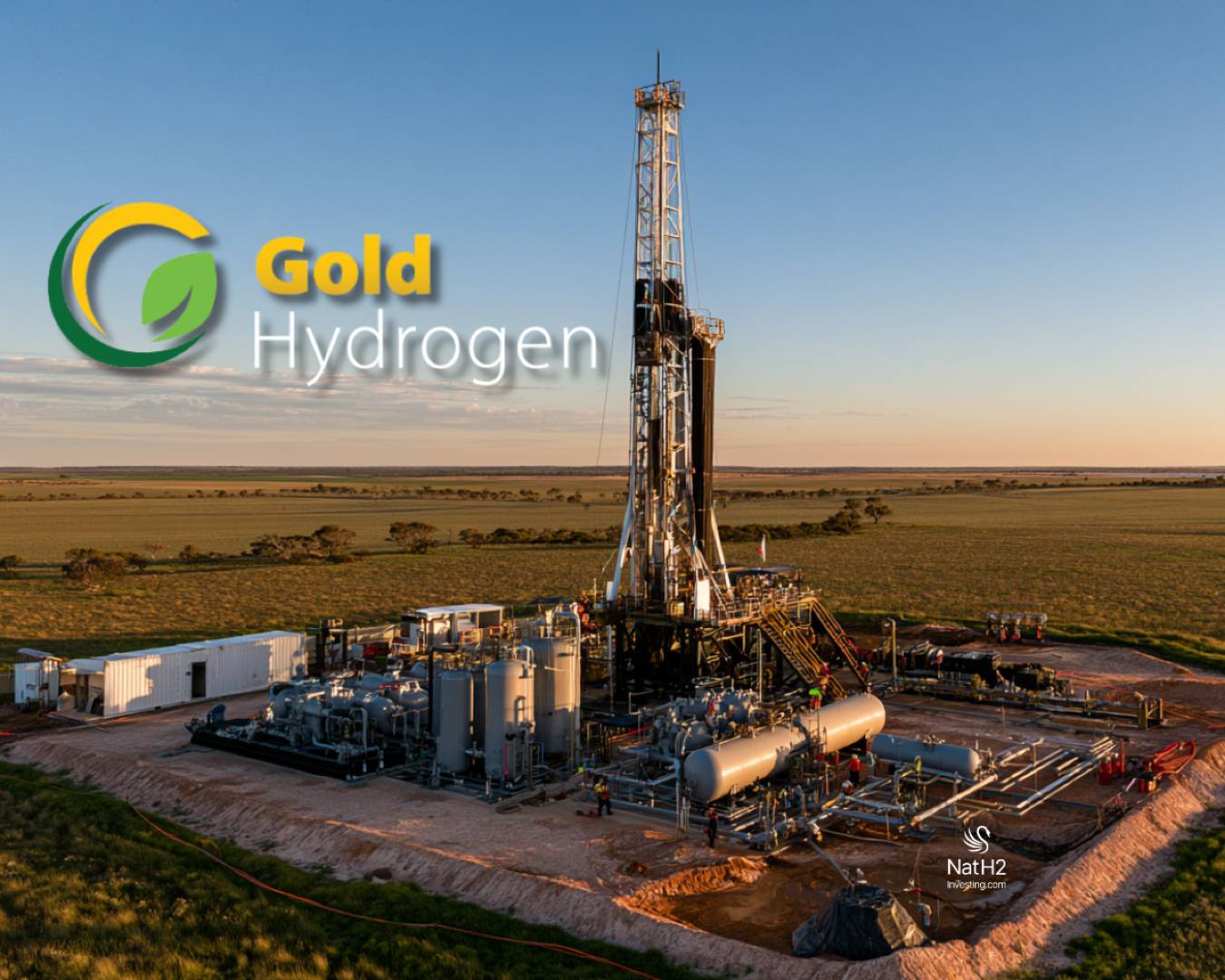
Gold Hydrogen has begun the next stage of appraisal at its Ramsay Project in South Australia, moving operations to Ramsay 3 for a larger-scale natural hydrogen and helium flow-testing program designed to build on the results from Ramsay 1 and Ramsay 2.
Workover operations are underway at Ramsay 3, with flow testing scheduled to begin immediately afterward. The well has been specifically designed to test the Ramsay system under substantially greater flow conditions than were possible during the company’s earlier testing.
The most significant change is the well design: Ramsay 1 and Ramsay 2 were completed with 4½-inch casing, while Ramsay 3 uses a 7-inch cased and cemented wellbore. That provides approximately 2.3 times the cross-sectional area and allows Gold Hydrogen to deploy an electric submersible pump with capacity of up to 20,000 barrels per day.
By comparison, the earlier Ramsay wells were tested using 2,000-barrel-per-day ESP systems, meaning Ramsay 3 gives the company considerably more pumping capacity with which to evaluate reservoir deliverability.
The testing will be conducted on a zonal basis. Selected intervals are being perforated initially for helium flow testing, followed by a natural hydrogen flow test. The objective is to evaluate individual gas-bearing reservoirs while testing whether the stronger pumping system can translate the reservoir characteristics identified through earlier appraisal into higher sustained flow rates.
Formation evaluation has also strengthened Gold Hydrogen’s geological model ahead of the test.
Nuclear Magnetic Resonance, acoustic imaging and resistivity imaging have identified what the company describes as favourable porosity, natural fracturing and fluid mobility within the gas-bearing Parara Limestone, Kulpara Dolomite and Winulta Sandstone at Ramsay 3.
Gold Hydrogen says the formation evaluation also supports lateral continuity of key gas-bearing zones between Ramsay 2 and Ramsay 3, which are approximately 2.3 kilometres apart. The interpretation provides further support for the company’s view that the natural hydrogen and helium-bearing formations extend across a broader area rather than representing an isolated occurrence.
NMR analysis carried out following drilling identified a strong interpreted dissolved-gas effect between 682 and 690 metres. Gold Hydrogen says Ramsay 3 contains a total of approximately 105 metres of helium gas anomalies interpreted to have similar characteristics within the Kulpara Dolomite, which are planned for perforation and flow testing during the campaign.
The NMR log presented on page three of the announcement illustrates the interpreted helium anomaly within the 682-to-690-metre interval, with the analysis highlighting responses the company associates with gas alongside formation water.
Ramsay 3 follows a series of flow-testing results from Ramsay 1 and Ramsay 2 that have progressively developed the company’s understanding of the system.
Those wells have supported Gold Hydrogen’s interpretation of a continuous and laterally extensive 180-metre gross helium reservoir. The company has flowed helium to surface at stabilized air-corrected concentrations of approximately 19% at Ramsay 1 and up to 20% at Ramsay 2.
Ramsay 2 also returned up to 20% air-corrected helium from the Kulpara Dolomite and 19% from the Hiltaba Basement without purification. Its testing reached gross fluid rates of up to 2,300 barrels per day, although the announcement notes that final flow rates have not yet been determined.
Gold Hydrogen has previously calculated reservoir productivity of up to 34 barrels per day per psi, with modeled raw gas rates of up to approximately 128 Mscf/day and helium rates of approximately 24.3 Mscf/day from the Kulpara Dolomite. Those higher modeled rates have not yet been demonstrated through flow testing, making Ramsay 3 an important test of the company’s scale-up assumptions.
The new well is therefore intended to address a different question from simply establishing the presence and concentration of gas.
With a substantially larger wellbore and a pump capable of moving up to 20,000 barrels per day, Ramsay 3 is designed to test how the reservoir responds under materially greater flow conditions and whether significant natural hydrogen and helium concentrations can be maintained as rates increase.
Full press release can be found here.